
Murmuration — Quick Start
Swarm reverb engine · VST3 · AU · AAX · macOS & Windows
The idea
Murmuration is a 64-line feedback-delay-network (FDN) reverb whose tail is shaped, moment to moment, by a self-organising flock of boids. Every delay line is modulated and panned by the swarm — the reverb takes on a life of its own: a detailed room model gives the realism, the swarm gives it life. Seven voicings cover the essentials, plus a gated Non-Linear mode for big, abrupt drum-room sounds.
Install & activate
1. Run the installer (macOS .pkg / Windows). It installs VST3, AU (mac) and AAX. 2. Open the plug-in in your DAW — it's fully featured for 14 days. 3. To activate: click the gear icon → Import License… → select the .license file from your purchase email. Unlocks instantly, offline.
The interface
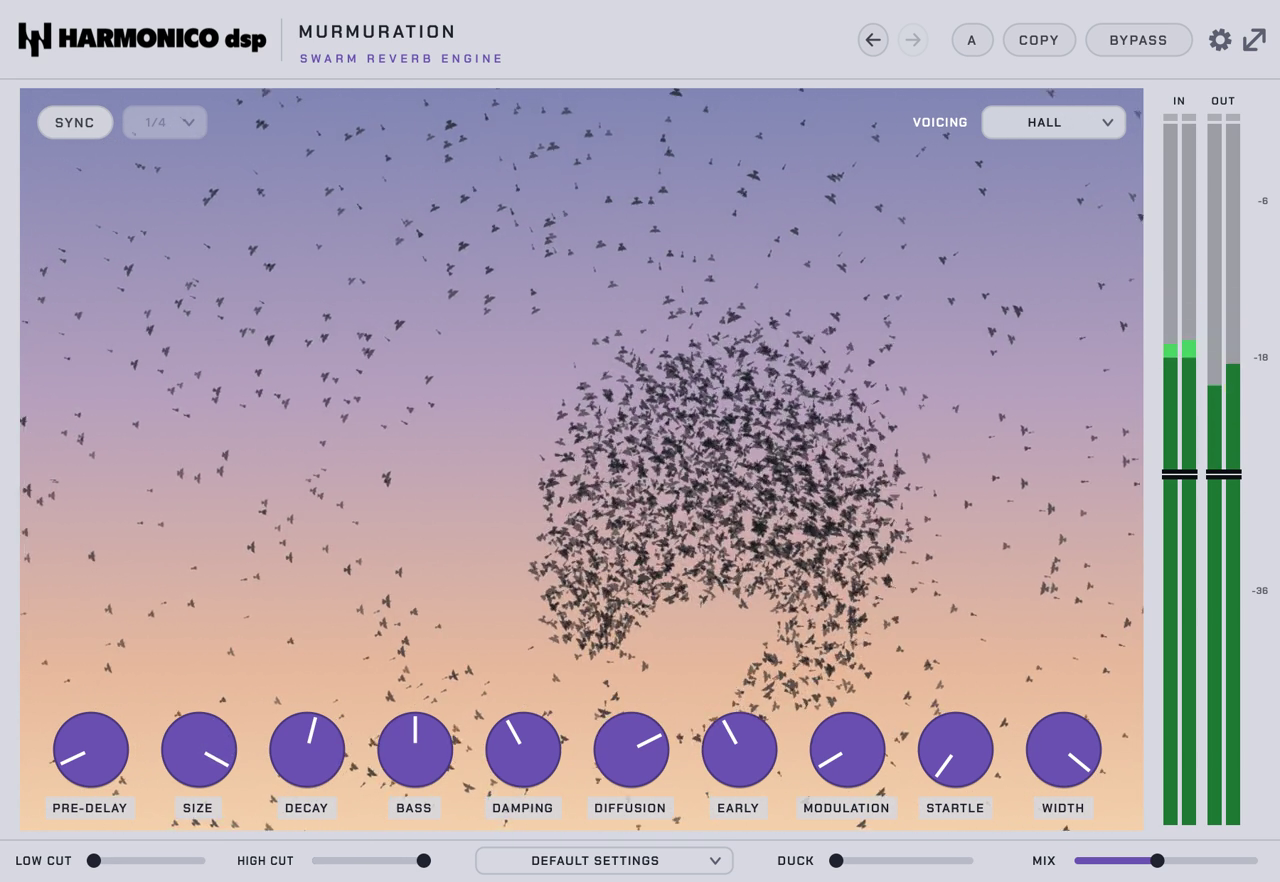
- Mode — the voicing (7, see below).
- Space — Size, Decay, Pre-Delay (with Tempo Sync).
- Tone — Low Cut, High Cut, Bass, Damping.
- Character — Diffusion, Early, Modulation, Startle.
- Output — Duck, Width, Mix, Input/Output. Two visual themes: Sunset Sky and Sardine Sea.
Controls
| Control | What it does |
|---|---|
| Mode | The voicing — 7 (see below). |
| Size | Physical size of the space — small booth ↔ vast hall. |
| Decay | Reverb time (how long the tail rings). |
| Pre-Delay | Gap before the reverb starts; Sync / Sync Div locks it to tempo (1/1 … 1/16). |
| Low Cut / High Cut | Filter the reverb's lows and highs. Send-only — your dry stays full-band. |
| Bass | Low-frequency decay / weight of the tail. |
| Damping | How quickly highs fade over the tail — darker as it decays. |
| Diffusion | Density and smoothness of the tail (grainy ↔ glassy). |
| Early | Early/Late balance. Left = early-dominated (smaller, drier); right = big lush late tail; centre = balanced. |
| Modulation | How much the swarm modulates the delay lines — this is what makes the tail move and breathe. Always on. |
| Startle | A transient flight reflex: how hard the swarm scatters when it hears an attack. Off by default (0) and ignores pads/sustained sounds — it only fires on hits. |
| Duck | Ducks the reverb under the incoming signal so the source stays clear. |
| Width | Stereo width of the reverb. |
| Input / Output | Gain trim in/out. Pushing Input drives the tank harder → a warmer, denser tail. |
| Mix | Dry/wet. |
The 7 voicings
- Room · Chamber · Hall · Cathedral — natural spaces, small → epic.
- Plate — classic bright plate sheen.
- Ambience — short and early-reflection-dominated: "air" and depth without a long tail.
- Non-Linear — gated / abrupt. Controls are reinterpreted: Decay = wall length (≈50–800 ms), Size = wall density, Damping/Diffusion = the wall's colour. It's a flat held wall then a hard cut, triggered by transients (so it ignores drum spill).
LFOs & modulation
Two assignable LFOs live in the drawer on the right edge (click the LFO tab).
- ASSIGN — click, then click any knob to route the LFO to it (several targets
per LFO are fine). CLEAR removes the routing; the modulation rings on the knobs show depth at a glance.
- RATE / DEPTH / PHASE — speed (free Hz or synced divisions), amount, offset.
- SYNC — locks the LFO to the host transport: cycles land on the beat
during playback (PHASE shifts the downbeat), so what you hear is what bounces.
- LFO routings are saved with presets and the A/B slots, and cleared by
DEFAULT SETTINGS.
Quick recipes
- Vocal hall — Mode Hall, Decay mid, Pre-Delay ~40 ms (or Sync 1/8), Duck up so the vocal stays forward, Mix ~25 %.
- Living plate on snare — Mode Plate, Modulation up, High Cut to taste.
- 80s gated drums — Mode Non-Linear, Size large, Decay = the wall length (short-to-mid); it fires on the hits.
Tips
- Modulation is what makes it move — a static reverb has none. Nudge it for life. (Startle only adds a reaction to hits.)
- Use Duck on busy sources (vocals, drums) to keep the dry signal clear.
- Sync the Pre-Delay to the track for rhythmic, in-time reflections.
- Want it warmer/denser? Push Input to drive the tank harder.
Specs & support
VST3 · AU · AAX — macOS & Windows. 14-day full trial. Questions? See the contact page on harmonicodsp.com.